
Katie Within Cultural Context
Katie is presented as a child firmly rooted in 1962. Her formal manners, respectful speech, traditional appearance and trusting nature accurately reflect the film’s image of childhood from an earlier era.
To modern viewers, Katie may seem unusually gentle, polite or childlike. Within the historical world the film creates, however, these qualities help establish her as a believable child of her time rather than simply an unusual personality made just for the film.
This historical contrast is important to her character. Katie represents not corrupted innocence, but innocence placed in danger—And a vision of childhood which the modern world may perceive as fading.
Katie and Changing Ideas of Childhood
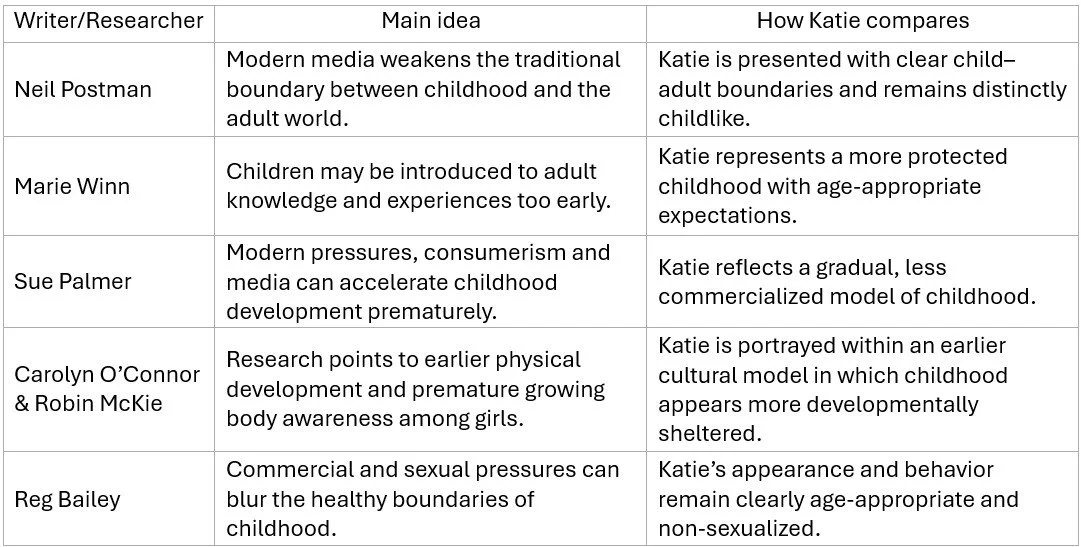
The researchers describe different ways childhood can become accelerated or less protected. Katie represents the opposite image—A child whose identity remains clearly separated from the adult world.
Although these writers and researchers approach childhood from different perspectives, they share a concern modern children can be exposed to adult knowledge, media, commercial pressures, sexualisation and premature developmental expectations at increasingly younger ages.
Katie provides a strong contrast. Her 1962 characterization emphasizes clear boundaries between childhood and adulthood through her manners, play, family relationships, modest appearance and dependence upon caring adults. She is presented as a child who has not been pushed precipitately toward the adult world.
Within this framework, Katie functions almost like a cultural time capsule. Her innocence is not portrayed as ignorance or weakness, but as part of an insulated stage of life which the surrounding adult world should preserve rather than destroy.
For modern viewers, this may help explain why Katie can seem unusually childlike. She represents a vision of childhood which feels increasingly distant—One defined by gradual development, clearer boundaries and preserved innocence.